Showing posts with label history. Show all posts

Monday, October 22, 2012

Fashion Flashback: 1950

Hello There, Glamour Dolls!

I was in the mood for bringing you some Vintage Fashion so here are some wonderful photos from two 1950 editions of LIFE magazine which capture the essence of American fashion in that year. 

As you'll probably notice, with the daytime fashions some of the utilitarianism that was so prominent in 1940s fashion is still evident although the flamboyant glamour that would later trademark the decade is starting to shine through in the evening wear. 

Enjoy!

P.S. Can you spot a young Janet Leigh (later of Psycho fame)?


And underneath it all...


Original Photographs are property of LIFE magazine. This is for entertainment purposes only. No copyright infringement is intended.

Thursday, October 18, 2012

St. Louis LIFE March 8, 1948

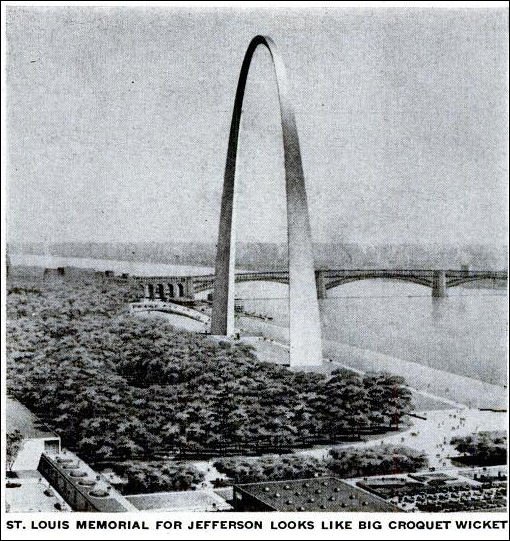
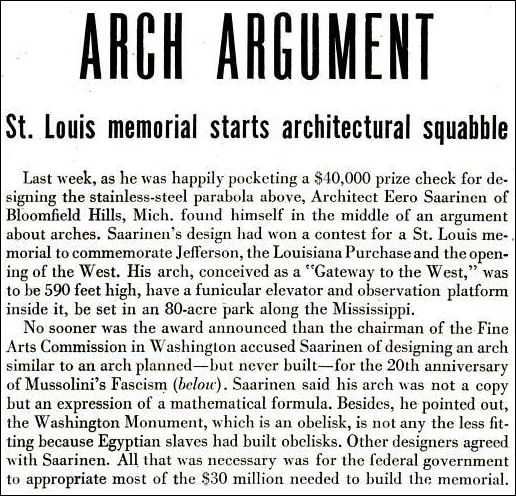
A  bit of a follow up from the last post, and rewinding further into the past we find St. Louis in the spotlight in 1948 as the first plans for the Gateway Arch were unveiled.


A croquet wicket? I've never heard it described as that but I suppose it reflects the sentiment of the time. 


For those of you familiar with it, the Arch once completed on May 25, 1968 (20 years after the original proposal) stood 630 feet- making it the tallest monument in the United States, a title it retains to this day.

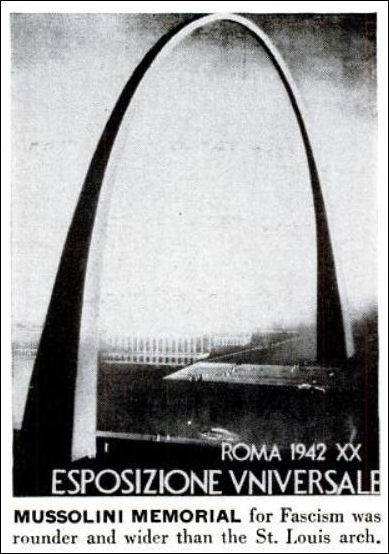
Below is the proposed 'Mussolini Memorial' for the Esposizione Universal di Roma in 1942. However, the 1942 World's Fair in Rome never came to fruition and the Arch's possible inspiration was never constructed.


I have always thought the St. Louis Arch beautiful- it's miraculous to think that it was designed while still in the shadow of the aftermath of World War II as it's so mid century mod. It sets the St. Louis skyline apart from other cities throughout the Midwest and the United States. 

It's stunning no matter the time of day or time of year.


Stay Glamorous!

St. Louis LIFE Nov 14, 1960

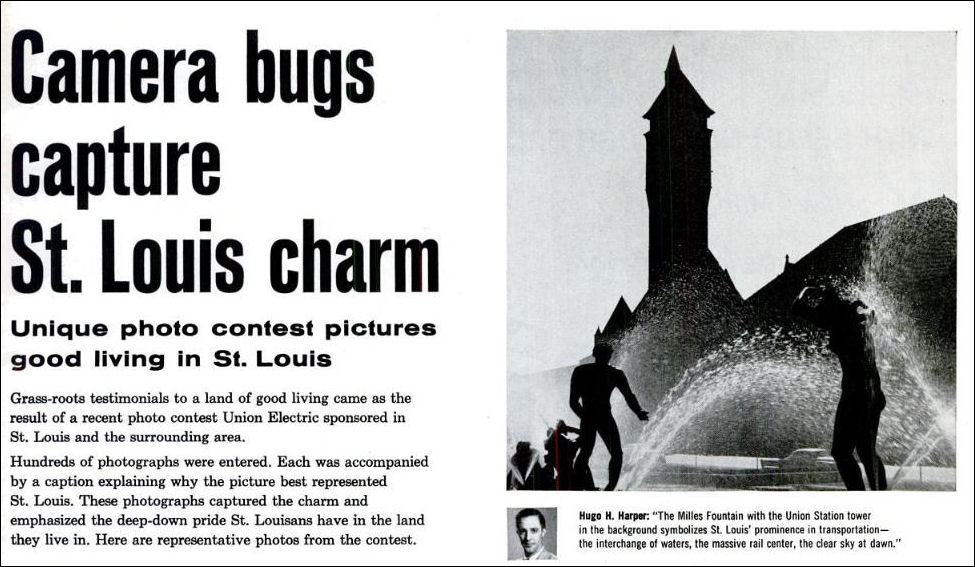
As you may know, I have an obsession with vintage Life magazines. I thought I'd share some treats from the Nov 14, 1960 issue featuring a spread on my beloved St. Louis.

We open with a stunning picture of St. Louis Union Station juxtaposed behind the Carl Milles Meeting of the Waters fountain. I worked at the hotel portion of St. Louis Union Station when I first moved to St. Louis from Australia. 


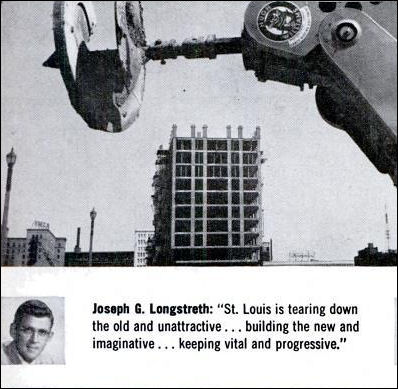
This below photo is bittersweet. In one respect, it goes to show how the once prosperous St. Louis was keeping up with the times and moving ahead to become a city of the future in the optimistic mid 20th century. However, it is also a reminder that St. Louis has lost more architectural treasures to the bulldozers and wrecking balls than most cities have to begin with!


It's no understatement that St. Louis was once considered the driving force in making 10 Pin Bowling one of America's favorite retro pastimes. Although the Bowling Hall of Fame shut it's doors and headed south in 2008, Saratoga Lanes in the St. Louis suburb of Maplewood is still operating after almost 100 years with few major changes.


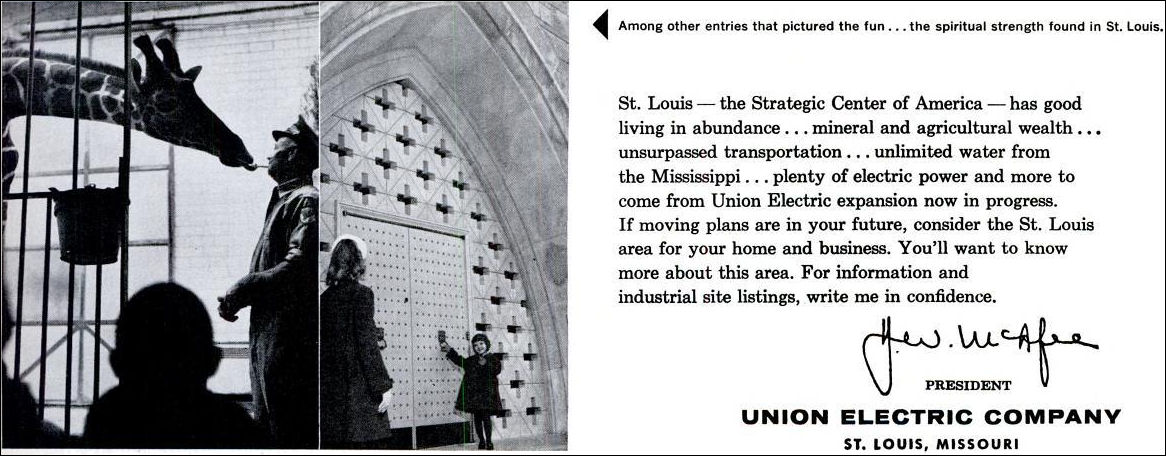
I love the optimistic sentiment of Union Electric's spiel below. Union Electric is still St. Louis major provider of electricity, although is now marketed under the name AmerenUE. 


Whether you're a St. Louisan or not- I hope you enjoyed this blast from the past :)

Stay Glamorous!

Wednesday, September 26, 2012

Mid Century Modest vs The McMansion PART 1

Evening!

I think I need to rectify / justify a comment I made in my Target Haul post yesterday. I stated that the house DH & I purchased was over 3 times the size of my prior home. This is true, but only because our last house was tiny! Our new Mid Century Modest ranch is just over 1500sqft on the main floor or 2100sqft including the finished section of the basement (plus another 900sqft unfinished but the only things in there are the washer, dryer, furnace, etc). With that said, the house DH & I have lived in the past few years was just a tad over 700sqft (so a third of the finished area of our new house). 

Personal numbers aside though... compared to the average, new American home, our house is small. Neither Jon or I wanted a 'McMansion' though. We saw a fair few listings for them within our price range, but aside from not being our cute little Mid Century Modern dream, a McMansion just wouldn't fit our lifestyle or attitudes. 

Sure, I would ideally love a big walk in wardrobe and huge master bathroom. But do I really need a 'Master Suite', Media Room, Atrium Ceilings and everything in between? No, not for the life Jon and I have planned out for ourselves.

So, without offense to anybody here, let's talk about house size over the past decades:

The 1940s:
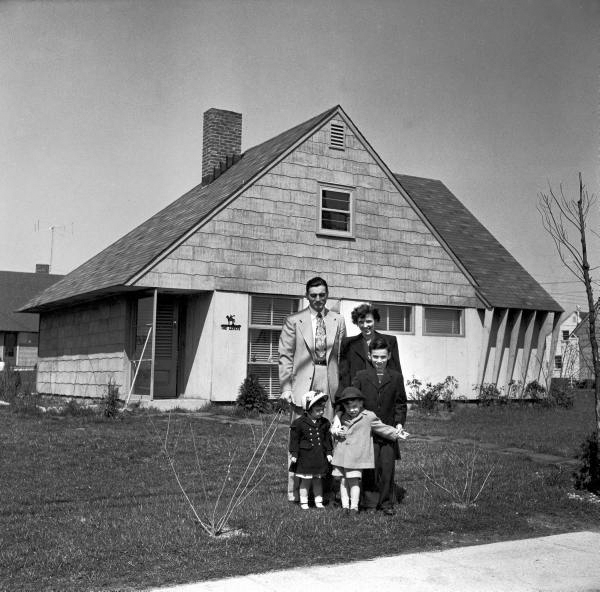
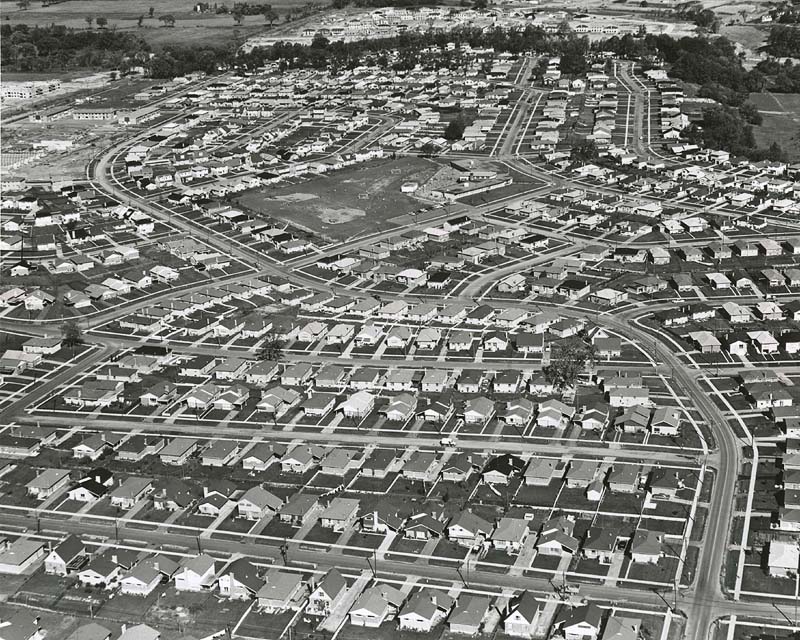
In 1940, according to the U.S. Bureau of Statistics the average newly built house size was 1200sqft. Following World War II however, the baby boom also meant a housing boom for the suburbs. Largely recognized as the first planned 'Suburb', Levittown on New York's Long Island (incidentally where my mother-in-law grew up) started in 1947 with modest 2 bedroom house plans of 750sqft. 


Why the sudden dip in house size from 1940? Part of it was due to the 'mass production' idea of suburbia. These were modest houses for families of modest means- often leaving city apartment living for the greenery of suburbia. For the developer, they wanted to fit as many of these houses as possible on their land and get them up as swiftly and affordably as possible. It's not much of a stretch to say that many of the first owners of Levittown, NY properties were probably former GI's with young families who had not owned homes of their own before. They were, what we would now describe as starter homes.

In 1949, due to the burgeoning interest in California style homes, the Levitt Brothers revised their home plans to appear more like the Ranch House that later became so prevalent in the 1950s. The new Ranch floor plans were 800sqft. 


The Levitt's went on to build 3 more suburbs called Levittown throughout the U.S. in the 1950s (Pennsylvania, New Jersey and Maryland) in addition to one in Puerto Rico in the early 1960s. The swaths of suburbia had begun. The Levitt Brothers may have started the craze but it was soon duplicated and modified all throughout the U.S. 

The ideology of the American Dream as we think of it today, had begun.


The 1950s:
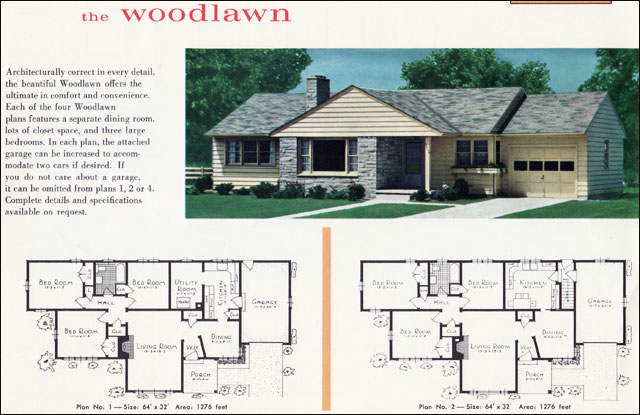
By the 1950s, square footage had increased to 1000sqft. Up from the Levitt Brother's initial suburban plans, but still a decrease from the standard in 1940 (during the pre-suburban boom). Unlike the original Levitt plans however, the average home size built throughout the 1950s featured 3 bedrooms for the growing, post-war family. 

While it was common in the earlier part of the century for children to share a bed, the notion was becoming outmoded in the U.S. with the new found prosperity. It was now commonplace for children to all have their own beds, and where possible, their own bedrooms. 


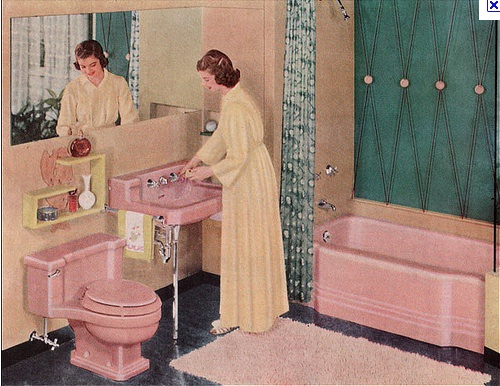
In these houses, 1 bathroom was still 'the norm'. Considering that as recent as World War II, a third of homes in the U.S. still didn't have indoor plumbing compared to the majority by 1950, it was still somewhat of a luxury to have a complete indoor bathroom. With that said however, the  bathroom size had somewhat reduced since the earlier part of the century (although in the earlier part of the century it was often only the upper middle classes and wealthy who had indoor bathrooms, or else a former bedroom was converted to be one). The decrease in bathroom size throughout new builds in the 1940s and into the 1950s was to economize on space and costs. Despite the economical size however, color permeated bathrooms with more vigor and excess than it had done in previous decades- Peacock Blues, Greens, Yellows and of course my favorite, Mamie Pink.


Be sure to check out Save The Pink Bathrooms


Another important shift in 1950s house design in the U.S. was the trend toward integral garages. 

The United States was automotive- crazy. By the end of the decade, 80% of American homes had at least 1 vehicle. 15% of American homes had 2 or more. In 1956, the very first stretch of the Eisenhower Interstate System was laid in St. Charles, Missouri (in the Greater St. Louis region) and is now part of I-70 which stretches from Maryland on the East Coast to Utah. The interstate system was another blow to inner cities all throughout the U.S. as they allowed people to live further out into suburbia yet still commute to their downtown jobs with ease. 

To keep up with this new, autocentric world, attached garages became commonplace in suburban subdivisions throughout the United States in the middle to late 1950s. 


The Kitchen, too saw a shift throughout the decade. At the beginning of the 1950s, the average Kitchen size was 78 sqft and by the end of the decade, 95sqft (almost the 100sqft it is today). The notion of Post-War domesticity and the vision of the ideal 1950s homemaker no doubt attributed to the focus on larger kitchens. Additionally, the number of Kitchen Appliances (both luxury and the norm) available to the average consumer was greater than it ever had been. Refrigerators, Dishwashers, Stand Mixers, Toaster Ovens and many more gadgets were making their way into American kitchens.


British cousins across the pond however, didn't have it so good yet (yes, that's a pun on PM Harold MacMillan's quote). American Homes vs British Homes throughout the century though will have to wait until another post, or you'll be here all day reading! 

My house was built in 1959 and almost fits the archetypal notion of a suburban fifties home. This particular subdivision, although modest by modern standards was better than average when the plot lines were drawn and these houses went up. In fact, Florissant's long-serving mayor (the second longest serving mayor in the U.S.), James J. Eagan lived in the subdivision for decades from the time it was built. Henceforth, the houses were a tiny bit larger than your average 1950s home. An extra bathroom here, a bit of extra square footage there. Not luxurious or extravagant by any means, but no doubt a welcome change from the cramped city conditions, and a step up from the first wind of suburban homes in metro area's 'inner rings'. 

By the end of the decade, the sprawl that began in the 1940s was reaching dizzying heights with tracts of farmland and wilderness throughout the country being razed to make way for the new suburbia.


The 1960s: 
The 1960s began with even larger houses- 1200sqft. The average layout of the 60s home wasn't too different from the 1950s but often incorporated more living space and a tiny bit of extra bedroom space, often in the form of built in closets. 

If you have lived in or toured a modest 1950s suburban home (especially from the earlier part of the decade) you will know that closet space is a luxury! Many 1950s houses I've seen only had a single door closet in the bedrooms- can you imagine? It's not because builders were being stingy- but because people genuinely had less than we do today. However, as the 1950s saw a dramatic rise in consumerism during the prosperous Post-War years, houses toward the end of the decade and particularly beginning in the 1960s featured larger closets. 


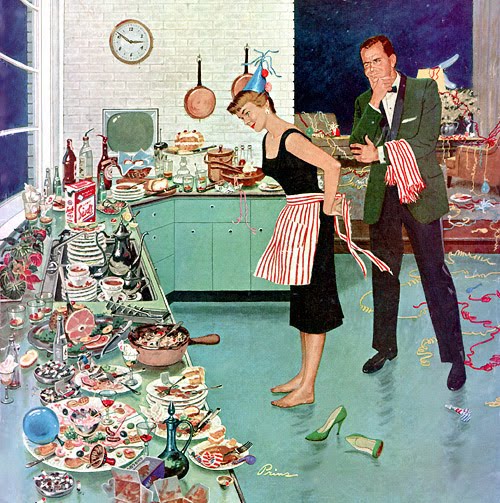
The extra living space, as before touched upon, was due to the increased importance in home entertaining. For those of you familiar with Mad Men, you will also be familiar with the parties thrown by Don & Betty and the prominently placed Betty Crocker Hostess Cookbook in Betty's Ossining home kitchen (faux pas though on the prop departments behalf! The book was published in 1967, a few years after that particular season of the show was set!).


As I personally own a copy of the book, I can guarantee that as fun as it is, it's more of an insight into 1960s living and expectations than anything else. It assumes that you are married, or planning to get married. It assumes that your husband will want his boss over for dinner. It assumes that you will want to get ahead in society. 

The solution, to make your husband, friends, husband's boss and your society acquaintances happy? Dinner Parties, Cocktail Parties, Buffets, Ladies Luncheons, Smorgasbords, and a plethora of other entertaining ideas, sure to run the hostess ragged. (As ragged as you may feel however, you still must look a treat!). 


More Americans now had the means to entertain. America was a wealthy, prosperous country in the early 1960s with a strong, comfortable middle class which could afford to entertain on a regular basis. Separate family rooms started to make their way into home designs- saving a formal Living Room strictly for company or entertaining, not unlike the concept of the Parlor or Front Room in Victorian and Edwardian times. 

I grew up in a 1960s home in Australia. It was reasonably spacious with 4 bedrooms and 2 bathrooms. Of course, it also had a Mamie Pink bathroom (which my mother is in the process of ripping out, ugh!). 

Unrelated to size, color in the 1960s (a continuing trend from the 1950s) also reflected the country's prosperity and positive attitude. Homes were lavished in bright oranges, greens and yellows and of course, a lot of Formica. 


By the end of the decade, houses had bulked out even more, with the end of the 60s seeing an average square footage of 1450sqft- almost double the Levitt's original suburban plan in the 1940s! 

The era of super sizing was approaching.


STAY TUNED FOR PART 2! 1970s-1990s!
Tuesday, July 17, 2012

St. Louis Love: Grocery Stores

Goodness Gracious Me...

Am I that boring that I'm going to tell you all about Grocery stores? Yes. Yes I am. I love grocery stores. I buy ingredients at grocery stores to bake and cook amazing things. I'm very darn good at cooking and have honed my craft immensely over the past couple of years. 

One thing (of many) I hate about Podunktown, North Cackalackee where I'm currently stuck- is grocery stores or lack thereof. My options are Food Lion, Walmart and Piggly Wiggly. I have never shopped at Piggly Wiggly. I refuse to shop anywhere that gives me horrible visions of an unhappy Wilbur in Charlotte's Web. Piggly Wiggly may have brought us the "modern" grocery store concept that we all know and love... but come on, change the name! 

Food Lion recently got ranked as one of the Top 10 worst Grocery Store chains in the United States. If you've never been to one- they're pitifully small. About half the size of a 'regular' grocery store. On the plus side- I prefer them to Walmart because you get less crazy riff raff, and my shopping trip is usually quicker due to the smaller size. I avoid Walmart unless I really have to go there for something. I have a choice of 2 Walmarts here in Podunktown- one of which is the busiest East of the Mississippi. Seriously. 

For a decent grocery store experience, I currently need to go to Lowes Food in Cape Carteret, or even better, Harris Teeter in Wilmington (Harris Teeter on the flip side is ranked in the Top 10 Best Grocery Stores in the nation). 

All my problems and frustrations with my grocery store experience however will vanish when I return to the Lou! Now let's see... Grocery Stores in my beloved St. Louis include:

Schnucks: Oh Schnucks I love you. You have a stupid name, but you are oh so wonderful! Everything about Schnucks makes me happy. They usually have great produce at affordable prices, a well stocked beauty / drug store section, and even fresh little refrigerated meals and sides (The Green Beans Almondine is fabulous if you don't feel like cooking a side!). 

Dierbergs: A fancier, step up from Schnucks but oftentimes worth the trip. The St. Louis Gooey Butter Cake in their Bakery section is amazing. (Better than Schnucks, sorry Schnucks!). Of course, I bake an awesome Gooey Butter Cake too! Dierbergs is usually a bit more expensive than Schnucks but often has products not at Schnucks (I think Dierbergs currently carries Gardein Vegetarian products... yummy!)

Straubs: If I was made of money, I'd probably still shop at Schnucks & Dierbergs, but Straubs is an absolute treat. It's the optimum in quality and carries all of those elite hard to find ingredients you saw last season on Top Chef. One of my managers when I used to live in St. Louis used to go to Straubs daily. I don't think he could cook. I think he focused primarily on their fresh 'ready made' meals. Seriously though- you have to be earning some $$$ to be able to afford Straubs on a daily basis.

Trader Joes: Can you believe I never went to Trader Joes when I lived in The Lou? Actually- I've never been to a Trader Joes, period. I'll be sure to check it out though upon my return.

Whole Foods: I love Whole Foods. I crave certain things from Whole Foods. Unfortunately, they're also super expensive - I can usually get the same Organic produce I would get at Whole Foods at Schnucks or Dierbergs for about half the price. My Whole Foods trips will then be solely for items I can't get at any of the more affordable stores. 

World Market: Not strictly a Grocery Store- but it does have a grocery section. I have to currently travel an hour to my local World Market for my Australian/ British pantry supplements like Golden Syrup, Vegemite, Marmite, and Bundaberg Ginger Beer. Yummy.I'm just beyond annoyed that they no longer carry Cadburies. What's with that? Nestle isn't nearly as good! 

Stelmacki: I really, really want to check out Stelmacki when I'm next in the Lou. Chances are, I'll be living near-ish to Stelmacki due to our budget constraints (in NoCo by any means... don't knock it... NoCo is retro cool). Stelmacki came into being in the 1960s at the base of the Lewis & Clark Tower (there were meant to be two of them but the second tower never came into fruition). The 'Top of the Tower' restaurant is long gone, but Stelmacki still remains, complete with it's awesome Mid Century Modern signage. It's still owned by the same family and apparently not much has changed. I can't wait to live the 1960s grocery store experience! I'll let you know how it is when I move :)

Bill's Riverview Market: Another NoCo gem, yet another I haven't visited. According to the St. Louis Post Dispatch this is another family run, retro cool grocery store with old fashioned counters and old fashioned service. Another I'm looking forward to checking out!

Thies Farm: Strictly a Farmers Market type deal with loads of yummy, fresh, locally grown produce and preserves! 

Soulard Market: The oldest surviving Farmer's Market west of the Mississippi! It dates back to the 1700s and is still entirely wonderful. It's going to be receiving an overhaul in the near future to accommodate more modern standards and tastes however.
Aldi: We had Aldi in Australia as well. It's nothing I get excited about. It's just kind of... there. 

Anyway, I think that's about it! The ones I'm most looking forward to are Stelmacki & Bill's Riverview, mainly because I've been almost everywhere else and they are still largely into the realms of the unknown to me. If they're as amazing as I think they'll be, I'll be sure to let you know. 

In the meantime, Stay Glamorous!


I love LIFE

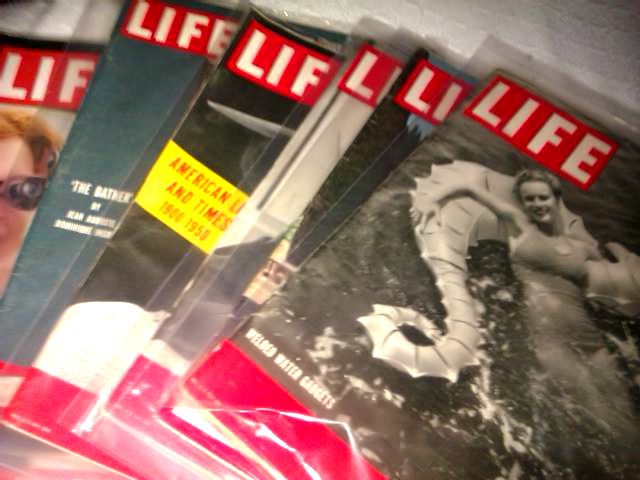
That's right folks... I love LIFE... magazine that is! I live vicariously through 1940s and 1950s LIFE magazines. I started collecting them last December during my trip to Florida to visit the inlaws. I bought the June 20, 1949 edition at a Flea Market / Antique Mall in Mt. Dora and you know I was hooked!

LIFE magazine premiered in 1883 as a general interest magazine and was reintroduced on 23 Nov, 1936 as a weekly news magazine. The archive from 1936 until 1972 is available online here. As great as it is to be able to read LIFE online, nothing can beat the feeling of turning the pages and having something tactile. This is part of the reason I refuse to have a Kindle or a Nook. There's no fun in reading a book that you can't touch. I love the smell of paper- the older the better. Digital book technology just doesn't interest me (says the girl writing a blog in a digital realm. Tsk tsk!.) 

Sadly, LIFE magazine as it was, ceased publication in the 2000s and now only appears on news stands as 'specials' from time to time. 

Right now, my LIFE collection is small- it grows only when I find a LIFE magazine from the 1940s or 1950s (got to limit it somewhere!) under $10, and in it's complete condition (no torn out pages or clipped out photos). 

The issues I currently have are:

July 15, 1946

November 1, 1948


June 20, 1949

January 2, 1950


October 22, 1956


August 26, 1957

December 28, 1959

I also have The Very Best of Life- 75 Years but haven't included it here as it's a modern 'special edition'. 

Anyway, I've been good about storing all of my LIFE magazines in plastic slips and keep all of them flat on my 1957 Drexel Counterpoint side table- except when I'm reading and re-reading them of course! (Excuse the glare from the plastic slips)


I haven't bought any 'new' magazines this year- with the exception of the LIFE 75 years special. I've been proud of myself! I figure if I focus solely on vintage magazines and nix the modern Good Housekeeping,  Better Homes & Gardens, Marie Claire and Glamour that I used to so desire, I'm not only going to save money but I'm going to get more enjoyment out of it. So far so good! 

I even enjoy the ads in old LIFE magazines- even though they are just 'dead' pages I skip over in modern magazines. Everything seemed better more than half a century ago! Vous ne pensez pas?

Stay Glamorous!